Mutual Funds

Mutual Fund

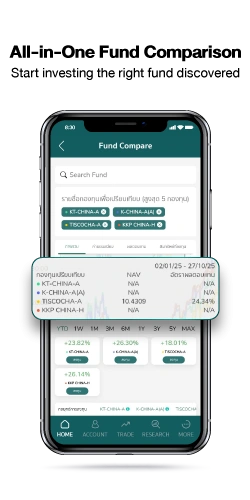
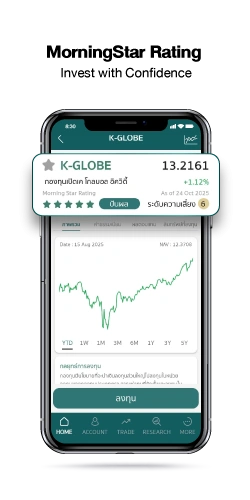
A wide variety of mutual funds from 18 asset management companies is available for you to choose from, including tax-deductible funds, foreign equity funds, mixed funds, fixed-income funds, and alternative asset funds such as gold, oil, and more.

Open an online account

Invest in Mutual Fund via KS ONE APPLICATION

Why Mutual Fund Investing with KS?

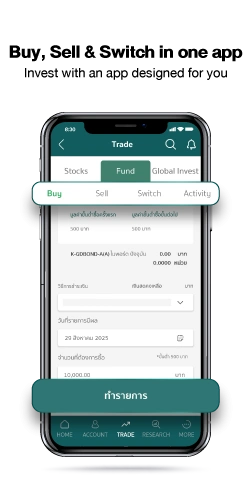
Convenient for buying, selling, and switching funds.

Buy, sell, and switch instantly via the KS ONE application.

Easily track your investment portfolio.

Easily track your portfolio movements anytime, anywhere via the KS ONE application.

Portfolios carefully selected and managed by investment experts.

Expert fund selection, portfolio construction, and insightful analysis — delivered by our experienced team.

Access to 18 Asset Management Companies.

A wide selection of mutual funds from 18 asset management companies — all in one place, with no extra fees.

Implication & Recommendations from KS

Investment Plan

15 - 19 December 2025

KS ASSET ALLOCATION

📌 Fed supports a Goldilocks outlook — accelerating GDP growth with inflation nearing its peak.
Buy on dip in tech stocks: earnings misses were driven by supply constraints, while demand remains strong.

🌍 Global equity markets were supported by the FOMC meeting, as the Fed cut rates by 25 bps and reaffirmed that rate hikes are not the base case, while revising 2026 GDP forecasts upward and inflation lower, reinforcing a Goldilocks scenario 🍯📈. Additional liquidity from T-bill purchases also supported risk assets. However, markets turned volatile late in the week due to sell-offs in tech stocks 📉 after Oracle’s earnings missed expectations and uncertainty around AI revenue visibility, pressuring the Nasdaq, while U.S. cyclical and small-cap stocks continued to outperform.

🌏 North Asian markets rose in response to the FOMC 🇯🇵🇰🇷, while Chinese equities remained under pressure from gradual stimulus measures 🇨🇳. India stayed volatile due to currency weakness, though medium-term earnings outlook remains positive 🇮🇳.

💡 Investment strategy: Recommend buying on dips in global equities as the core portfolio 🌐, with a focus on U.S. tech, Japan, India, and South Korea, benefiting from the AI and memory cycle 🤖💾.
💵 ONE-FFI: Wait & see amid FX volatility; set stop loss if THB strengthens below 31.50/USD.
🏦 U.S. financial stocks: Let profits run.

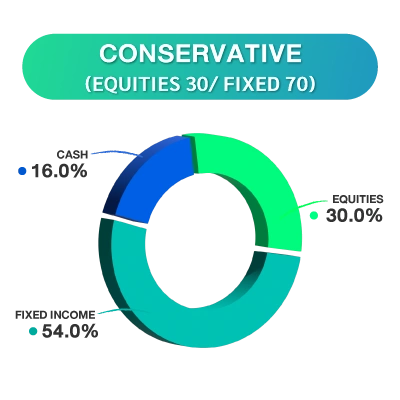
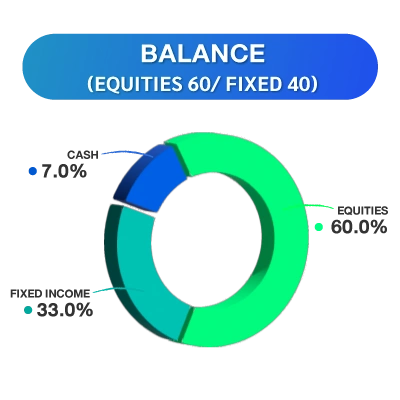
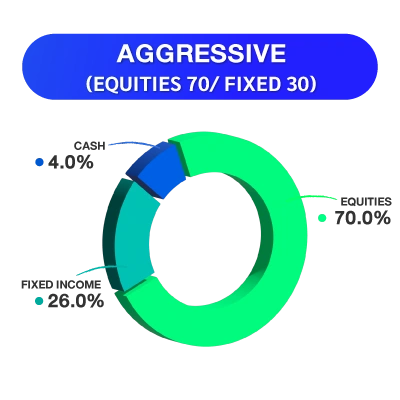
Tailored Portfolio Allocation

CONSERVATIVE MODEL

BALANCE MODEL

AGGRESSIVE MODEL

Tax Station

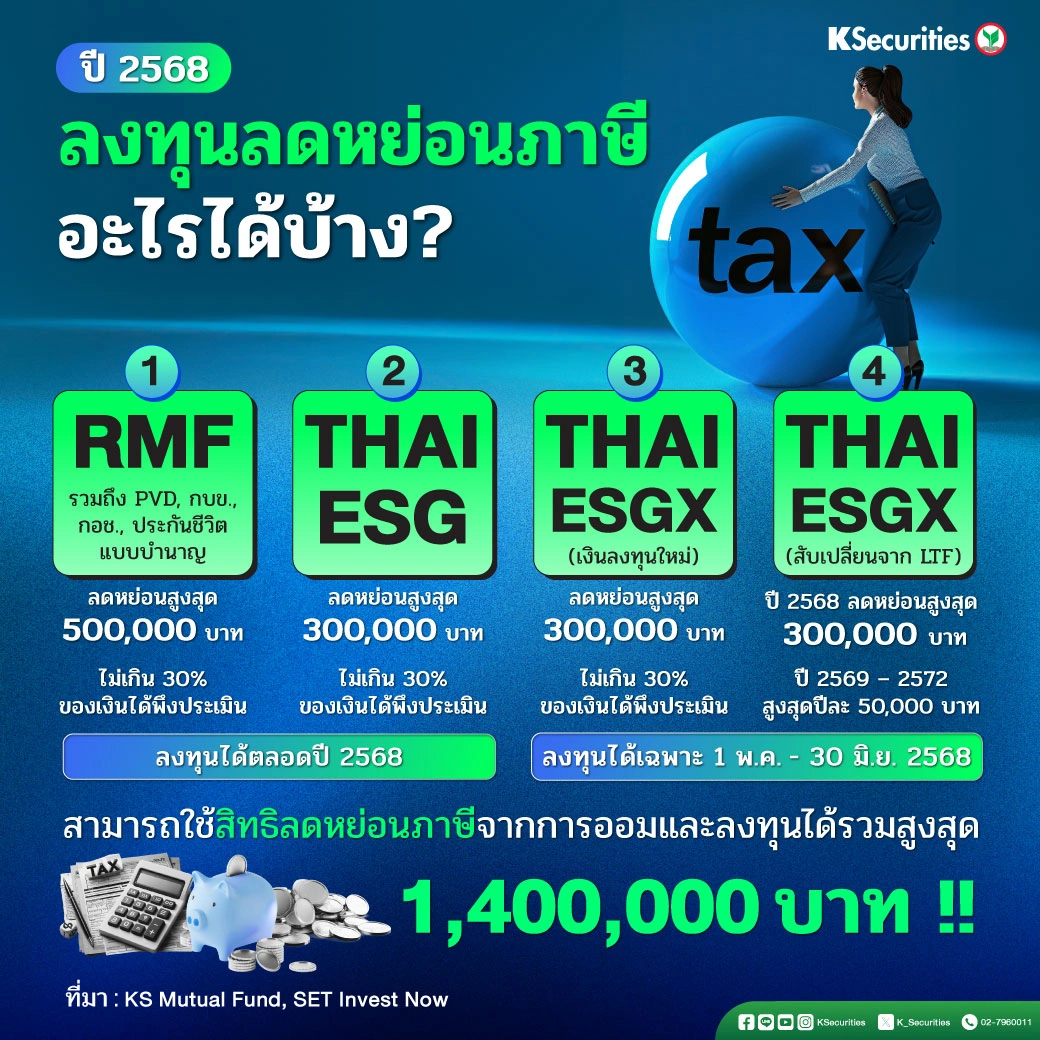
Tax Deduction Benefits for 2025

Maximize your tax-saving opportunities this year. In addition to securing your financial future through savings, you may be eligible for tax relief benefits of up to 1,400,000 THB.

1. RMF
2. Thai ESG
3. Thai ESGX (New Investment)
4. Thai ESGX (Switched from LTF)


Mutual fund's Recommended Video

Global Satellite EP.13

30 พฤศจิกายน 2568

Global Satellite EP.13

Lastest

KS Channel
KS Channel
KS Channel
KS Channel
KS Channel
KS Channel
KS Channel
KS Channel

Frequently Asked Questions

  • A Mutual Fund is a pooled investment vehicle. It's a structure where money from many different investors is collected and entrusted to a professional known as a Fund Manager. This manager then invests the total pool of money in various assets (like stocks, bonds, or real estate) according to the fund's specific investment policy. The goal is to generate returns, which are then distributed back to the individual investors in proportion to the amount they initially invested.

There are 8 main types of mutual funds, categorized by their Risk Spectrum (from lowest to highest risk).


  • Risk Level 1: Domestic Money Market Funds
    • These funds primarily invest in domestic deposits, bills of exchange, and debt instruments with an average maturity of less than 1 year. They carry the lowest risk and are suitable for investors who are very risk-averse or who need a temporary holding place for their cash.

  • Risk Level 2: Foreign Money Market Funds
    • Similar to Level 1, these funds invest in deposits, bills of exchange, and debt instruments with an average maturity of less than 1 year, but they may hold some international assets. This introduces currency exchange risk, though these funds typically employ foreign exchange hedging.

  • Risk Level 3: Government Bond Funds
These funds focus on investing in government debt instruments, such as treasury bonds or state-enterprise bonds, which mostly have an average maturity of more than 1 year. This longer duration makes them more volatile than Money Market Funds.
  • Risk Level 4: Fixed Income Funds
These funds invest in both government and corporate debt instruments (e.g., government bonds, corporate debentures). They can hold short-term (average maturity ≤ 1 year) or long-term debt (average maturity > 1 year). They suit investors who can tolerate low risk, seek steady returns, and want to diversify their portfolio.
  • Risk Level 5: Mixed Funds (or Balanced Funds)
These funds can invest in various asset classes including deposits, fixed income, and equities (stocks). The specific asset allocation is detailed in the fund's investment policy. They are appropriate for investors with a medium to high risk tolerance and those who lack the time to frequently adjust their portfolio during market volatility.
  • Risk Level 6: Equity Funds
These funds primarily invest in stocks (equities), both domestic and international. This category includes specific tax-advantaged funds like SSF and RMF that focus on equities. They are best for investors seeking potentially high returns who also have a high risk tolerance, or those who want to invest in stocks without managing the investment themselves.
  • Risk Level 7: Sector Funds
These funds focus their investments on stocks within a specific industry, such as banking, telecommunications, or healthcare. They carry higher risk than general Equity Funds (Level 6) due to this concentrated investment. They are suitable for investors with a high risk tolerance who possess a deep understanding of that particular industry.
  • Risk Level 8: Alternative Funds
These funds invest in assets outside of traditional categories, such as gold, oil, or commodities. They are for investors with the highest risk tolerance and those seeking further portfolio diversification. Investors should conduct extra research and understand the specific details related to these alternative asset classes.
  • NAV stands for Net Asset Value. It is the total net worth of a mutual fund on a given day, calculated by taking the fund's Assets minus its Liabilities (). The NAV represents the fund's true market value at that point in time.

You can open an account through the following online channels, with approval typically granted within one business day

  • New Customers/Online Application: Apply directly via our secure online platform: https://www2.kasikornsecurities.com/ksao
  • Existing KS Customers: If you are already a client of KS, you can open a mutual fund account through the "My Service" menu within the KS ONE application.
  • Other Channels: If you wish to open an account through other methods, please contact the KS Contact Center at 02-7960011.
Mutual funds typically involve two main types of fees:

1.Fees Charged Directly to Unitholders (Transaction Fees)
These fees are calculated based on the transaction value and are collected when you buy, sell, or switch units. They include: Front-end Fee: Sales charge (collected upon purchase). Back-end Fee: Redemption fee (collected upon selling/redeeming). Switching Fee: Fee for moving investment from one fund to another.
2.Fees Charged to the Fund Itself (Operating Expenses)
These recurring annual expenses are deducted from the fund's assets before the NAV is calculated:
- Management Fee (ค่าธรรมเนียมการจัดการ): The fee for the professional management of the fund, calculated as a percentage of the fund's net asset value (NAV).
- Trustee Fee (ค่าธรรมเนียมผู้ดูแลผลประโยชน์): Paid to the Trustee who safeguards the fund's assets and ensures the Fund Manager operates according to the approved policy. The Trustee must meet criteria set by the SEC (Securities and Exchange Commission).
- Registrar Fee (ค่าธรรมเนียมนายทะเบียนหน่วย): The cost for maintaining the register of unitholders and handling transactions.
- Other Expenses (ค่าใช้จ่ายอื่น ๆ): Miscellaneous operational expenses not covered by the fees above (e.g., auditing, legal, or fund marketing costs).

All in ONE Investment Application

Seamlessly connect to the investment world with KS ONE an all-in-one app offering complete investment solutions, from Thai equities to international markets.

Download

Search

Recommended searches